Greenhouse Mastery • 116 Tiles • Crop and ROI Strategy
Stardew Valley Greenhouse Mastery Guide: 116-Tile Layout, Crop Strategy, Automation, and ROI
Master the Stardew Valley Greenhouse with the 116-tile layout, Ancient Fruit vs Starfruit strategy, automation workflows, and practical ROI planning today.
Why greenhouse mastery changes your whole farm economy
The greenhouse is not just another farming area. It is a structural change to your economy. Outdoor fields are seasonal, weather-exposed, and calendar-constrained. Greenhouse farming is controlled, stable, and year-round. Once you understand this difference, your planning shifts from seasonal survival to continuous production design. That shift is exactly why many high-profit farms feel "effortless" after greenhouse setup: income smoothing replaces seasonal volatility.
In practical terms, greenhouse mastery does three things at once. First, it creates a reliable input stream for artisan machines, which increases conversion consistency and reduces idle time. Second, it stabilizes your cash flow between outdoor harvest spikes, making upgrades and materials easier to schedule. Third, it simplifies strategic decisions because one major production lane is no longer tied to season transitions. You still plan around outdoor opportunities, but your core engine keeps running.
This is why greenhouse optimization should not be delayed to "late game perfection". Even a partially optimized greenhouse can significantly reduce decision pressure. If your goal is a scalable profit system, use this guide alongside the Farm Profit Pillars guide and Artisan Profit Guide. The greenhouse is where those frameworks connect in daily gameplay.
Unlock timeline and preparation checklist
Many players unlock the greenhouse and then underuse it for weeks because setup was not preplanned. The right way is to treat unlock day as launch day. Before completion, you should already know crop plan, sprinkler placement, chest routing, and first processing batch flow. This prework determines whether greenhouse activation feels transformational or merely "nice to have".
Pre-unlock preparation priorities
- Store enough seeds to start meaningful density immediately.
- Prepare six Iridium Sprinklers (or a transition plan if fewer are ready).
- Place nearby chest infrastructure for fast harvest transfer.
- Map first conversion lane: which crops are sold raw vs processed.
- Secure material pipeline for machine expansion in the same period.
If you are still deciding the unlock path and milestone order, compare with the complete Year 1 roadmap. The two guides are designed to interlock: Year 1 sets constraints, greenhouse mastery converts those constraints into stable output.
116-tile layout explained step by step
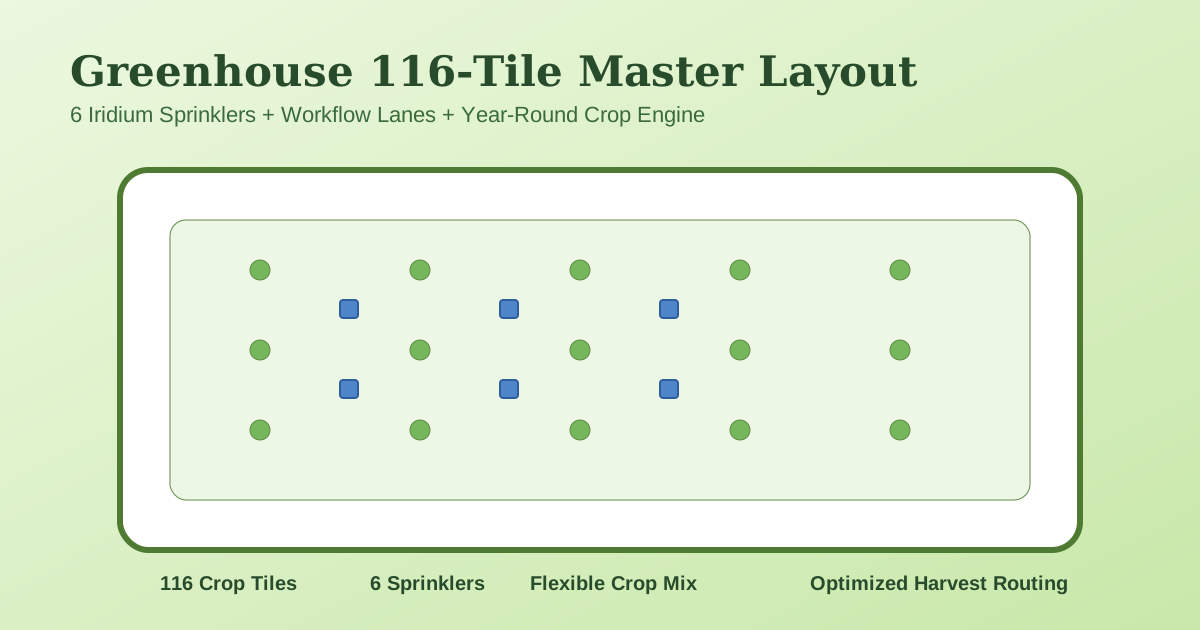
The 116 layout is popular for good reason: it balances near-maximum crop density with practical watering automation using six Iridium Sprinklers. In raw numbers, every tile in the greenhouse matters because these crops can feed premium artisan lines year-round. However, a dense layout only wins if your movement, harvest routing, and replant flow remain clean. Tile count is the start, not the finish.
Step-by-step setup
- Till all available interior crop spaces and identify sprinkler anchors first.
- Place six Iridium Sprinklers in optimized coverage positions.
- Fill all remaining tillable spaces as crop tiles for total 116 plant spots.
- Reserve access routes where your playstyle needs quicker replant loops.
- Set one chest just outside entrance and one near processing area for handoff speed.
If you need a visual companion and layout alternatives, read Greenhouse Layout Guide. This page focuses on strategic operations after layout completion.
Layout variants for different playstyles
Not every player should run the same greenhouse geometry. Your schedule, replant tolerance, and machine infrastructure all affect what is "optimal". The 116 pattern is a strong baseline, but variants can outperform it for specific constraints. For example, players with limited weekly play windows often benefit from slightly cleaner lanes that sacrifice a few tiles for lower friction. Meanwhile, high-attention optimizers may run strict density plus tight machine routines.
Common variant choices
- Full 116 density: strongest for disciplined weekly operators.
- 114-115 with comfort lanes: easier manual harvesting and replanting.
- Transition mix zones: temporary split between recurring and replant crops.
- Experiment lanes: small tiles reserved for short-cycle testing.
The best test is throughput, not aesthetics. Track whether your weekly completion rate improves with a variant. If harvest and refill cycles complete faster and backlog drops, the variant is economically superior for your run.
Crop strategy framework: choose by bottleneck, not hype
Greenhouse discussions often reduce to one question: Ancient Fruit or Starfruit? That is useful, but incomplete. The real sequence is: identify bottleneck, choose crop behavior, then size machine capacity accordingly. If replanting discipline is your bottleneck, recurring crops gain value. If machine slots are your bottleneck, high-margin per-batch planning becomes critical. If liquidity is tight, partial raw sales may be temporarily optimal even when full processing has higher theoretical yield.
Use the calculator with your exact assumptions and current day context. Then check whether your decision survives workflow reality. Many failed greenhouse plans are mathematically correct but operationally fragile. Sustainable profit comes from alignment between numbers and execution capacity.
| Crop approach | Setup profile | Workload profile | Machine fit | Best for |
|---|---|---|---|---|
| Ancient Fruit | Higher startup friction (seed multiplication) | Low after initial planting (weekly regrow) | Excellent with steady keg lines | Players who want consistency and low replant micro |
| Starfruit | Easy seed acquisition with high recurring cost | High (replant cadence + fertilizer decisions) | Strong with high keg capacity and disciplined workflow | High-attention optimization and burst profitability |
| Mixed strategy | Flexible and adaptive | Moderate depending on mix | Useful when keg count is still scaling | Transition phases and bottleneck testing |
Ancient Fruit vs Starfruit deep comparison
This debate is popular because both are legitimately strong. The mistake is treating one as universally better. Ancient Fruit tends to win in operational efficiency: once established, weekly regrowth supports consistent harvest cadence with low replant overhead. This frees time for mining, expansion, and machine management. Starfruit can produce excellent returns, but it asks for recurring seed purchases, regular replant cycles, and tighter timing control.
In high-discipline runs, Starfruit can outperform on certain profit metrics, especially when keg capacity and replant routines are robust. In practical, mixed-attention runs, Ancient Fruit often delivers better realized profit because fewer steps means fewer execution misses. Realized profit beats theoretical peaks that depend on perfect maintenance.
When Ancient Fruit usually wins
- You value stable weekly routines and low micro-management.
- You are still scaling keg count and want predictable input flow.
- You prefer long-term compounding over high-touch cycle optimization.
When Starfruit usually wins
- You can maintain strict replant cadence with minimal delays.
- Seed costs are controlled and do not hurt expansion liquidity.
- Machine capacity is high enough to prevent conversion backlog.
For scenario-specific math, continue with Ancient Fruit vs Starfruit full guide and wine-only comparison. If you are deciding quickly, use the quick answer version.
Automation and efficiency stack
Greenhouse output is only as strong as the system that handles it. Automation here does not mean fully AFK. It means reducing repetitive friction so high-value decisions get more of your time. The stack below shows the practical layers that drive reliable conversion and sustained growth.
| Automation layer | Recommendation | Profit impact |
|---|---|---|
| Irrigation | Iridium sprinklers with path-preserving placement | Removes daily watering cost and protects time for processing loops |
| Harvest routing | Dedicated chest lanes near greenhouse exits | Reduces travel waste and keeps refill sessions tight |
| Processing | Keg clusters by refill cadence | Improves machine uptime and backlog visibility |
| Material supply | Persistent oak resin and bar production pipeline | Prevents expansion stalls during high-opportunity windows |
| Decision support | Weekly calculator checks with days-left and bottleneck notes | Keeps crop selection aligned with current constraints |
The most frequent late-game greenhouse bottleneck is not crop choice, it is resin supply for kegs. Plan oak tappers early and keep the cycle uninterrupted. If your keg expansion stops, greenhouse value capture stalls. For machine-side scaling details, use how many kegs do I need and the full artisan pipeline guide.
Profit math and ROI planning
ROI in greenhouse setups is easy to misunderstand because returns are continuous and tied to multiple dependent systems. Instead of asking only "Which crop has higher sell price?" ask"Which full pipeline generates more realized value per week after accounting for labor, machine capacity, and bottlenecks?" This framing prevents misleading optimization.
| Scaling stage | Main investment | Expected return profile | Primary risk |
|---|---|---|---|
| Early greenhouse launch | Soil prep, sprinkler setup, first machine batch | Stabilized weekly income and reduced seasonal variance | Underbuilt machine capacity causing delayed conversion |
| Mid scaling phase | Keg expansion, resin pipeline, storage routing | Higher conversion rate and reduced idle crop inventory | Resin bottlenecks and chest backlog masking real constraints |
| Mature greenhouse system | Workflow polish, quality optimization, schedule discipline | Compounding high-margin output with low management waste | Over-optimization that harms practical consistency |
A simple ROI routine: every week, record harvest volume, machine idle rate, and chest backlog. If backlog rises while machines run full, expansion is justified. If machines sit idle, crop strategy or cadence needs adjustment. If both backlog and idle time occur, your workflow routing is likely broken. Use this diagnosis loop before spending heavily.
Weekly operating routine and checklists
The highest-performing greenhouse setups are routine-driven. They do not depend on mood or memory. Build a weekly operating loop that protects the essentials: harvest timing, machine refill, inventory conversion, and material continuity.
Weekly greenhouse checklist
- Harvest on schedule and replant immediately if running non-regrow crops.
- Refill processing machines in the same session to avoid idle drift.
- Audit resin and bar inventory versus your next machine expansion target.
- Check calculator assumptions if crop mix or profession state changed.
- Review chest backlog and clear delayed high-value items first.
- Reserve emergency liquidity before discretionary purchases.
Monthly greenhouse review (high value)
- Measure realized output, not only theoretical projections.
- Evaluate whether layout still matches your current crop strategy.
- Recalculate crop mix if machine capacity changed significantly.
- Adjust expansion targets based on true bottlenecks observed.
- Confirm your routine still fits available playtime realistically.
If your routine is becoming too heavy, simplify first and optimize second. Consistent execution beats complex plans that break after one busy week.
Scenario playbooks by farm style
A greenhouse system should match your actual play behavior. Two players with identical tile layouts can produce very different outcomes because their weekly attention patterns differ. To make this guide practical, here are three common playbooks. Use the one that resembles your reality, then adjust based on measured results.
Playbook A: Low-maintenance consistency (limited sessions)
If you play in short sessions and prefer stable progress, prioritize Ancient Fruit with a strict weekly cadence. Keep layout routes comfortable, protect machine refill sessions, and avoid high-frequency replanting strategies that create cognitive overhead. Your win condition is predictable completion, not maximum theoretical spikes. In this model, every missed task is expensive because fewer sessions mean less recovery capacity.
- Use regrow-heavy crop profiles to minimize mandatory touchpoints.
- Batch processing in fixed windows instead of frequent micro-refills.
- Favor layout comfort if it prevents delayed harvests and refill misses.
- Keep one emergency cash reserve to absorb missed cycle disruptions.
Playbook B: High-attention optimization (frequent check-ins)
If you enjoy optimization and can maintain regular touchpoints, Starfruit-heavy pipelines become more viable. The key is discipline: scheduled replanting, continuous machine loading, and strict inventory control. This style can produce excellent results, but only when process quality is high. If you often skip cycles, performance drops quickly and may underperform a simpler Ancient Fruit routine.
- Set fixed replant windows and pre-stage seeds/fertilizer in dedicated chests.
- Scale kegs in advance so high-value harvests are not delayed in storage.
- Use weekly KPI checks: backlog size, machine idle rate, and cycle completion rate.
- Reassess crop ratio monthly to keep operations aligned with real capacity.
Playbook C: Transitional hybrid (scaling from midgame to mature)
Many farms are in transition: some machines exist, resin is still constrained, and daily routines are improving but not fully stable. In this stage, a hybrid greenhouse is often optimal. Run a core recurring lane for consistency while allocating a controlled share to higher-touch crops. This gives you upside without destabilizing base operations.
- Anchor with recurring crops for baseline machine feed continuity.
- Add limited Starfruit blocks only when replant windows are guaranteed.
- Route overflow to selective raw sales to protect liquidity during expansion.
- Upgrade toward full specialization once bottlenecks become predictable.
The strategic takeaway is simple: greenhouse mastery is context-sensitive. Choose the plan that you can execute repeatedly, then improve it. A perfectly modeled strategy that your schedule cannot sustain will always lose to a slightly less efficient system that runs every week without fail.
Common greenhouse mistakes
Mistake 1: Prioritizing tile count over workflow
Maximum density is attractive, but if harvest and replant routes become awkward, practical performance drops. Evaluate layout by cycle speed, not screenshot symmetry.
Mistake 2: Running crop plans without matching machine plans
High-volume greenhouse harvests need conversion capacity. Without enough machines, value sits in storage and strategic momentum weakens.
Mistake 3: Ignoring resin bottlenecks until too late
Keg growth is constrained by oak resin. If you start resin planning late, greenhouse expansion slows exactly when opportunities are highest.
Mistake 4: Overcommitting to Starfruit without schedule capacity
Starfruit can be excellent, but replant discipline is mandatory. If your play schedule is inconsistent, Ancient Fruit often yields stronger realized results.
Mistake 5: Never reevaluating strategy after expansion
What worked at small scale may underperform at larger scale. Reassess crop mix and machine allocation after every significant capacity jump.
FAQ: Greenhouse Mastery
What is the best greenhouse layout in Stardew Valley?
For most players, the strongest general layout is 116 crop tiles using Iridium Sprinklers placed to maximize watering coverage while preserving workable movement paths.
How do you get 116 crop tiles in the greenhouse?
Use six Iridium Sprinklers in optimized positions and fill all remaining tillable spaces except sprinkler tiles. This creates 116 plantable tiles in the greenhouse.
Ancient Fruit or Starfruit in the greenhouse: which is better?
Ancient Fruit usually wins for low-maintenance consistency and smoother weekly cycles. Starfruit can beat it in high-attention setups with strong replant discipline and enough keg capacity.
Should I process all greenhouse crops into wine?
Usually yes for top long-term value, but only if machine capacity keeps pace. If kegs are a bottleneck, mix processed and raw sales to avoid liquidity problems.
How many kegs do I need for a full 116-tile greenhouse?
It depends on crop type and harvest cadence. Ancient Fruit has weekly rhythm, while Starfruit has replant cycles. Use your weekly harvest volume to size keg count and avoid long chest backlogs.
Can I use the greenhouse for year-round cash stabilization?
Yes. That is one of its biggest advantages. The greenhouse decouples core income from outdoor seasons, helping maintain steady machine input and cash flow.
Is Deluxe Speed-Gro worth it in greenhouse Starfruit runs?
It can be worth it when your schedule supports frequent replanting and your keg pipeline is ready. Otherwise, the extra management overhead may reduce practical efficiency.
When should I switch from mixed crops to a specialized greenhouse?
Switch when you know your bottleneck. If machine slots are stable and replant time is tight, Ancient Fruit specialization is often best. If you can handle replanting and maximize conversion cadence, Starfruit-heavy strategies can outperform.
What is the biggest greenhouse mistake?
Designing only for max tile count without considering workflow. A mathematically dense layout can still underperform if harvest, replanting, and machine refill routes are inefficient.
Next action steps
Start by validating your current greenhouse crop plan in the profit calculator, then compare your actual machine capacity against weekly harvest volume. If conversion bottlenecks are visible, prioritize pipeline scaling before changing crop strategy again.
Continue with Artisan Goods Empire for full processing network design.