Stardew Valley 1.6 · Decision guide
Best Greenhouse Crops: Ancient Fruit, Starfruit & Your Kegs
Choose mature Ancient Fruit for a weekly harvest routine; choose Starfruit when you have seed money and want higher value from each scarce Wine slot. New plants and a chest full of harvested fruit need different plans. Start with the state of your save, then count the machines.
By StardewProfit · Revised
Which crop fits your greenhouse now?
| Your starting point | Useful choice | What you must budget for |
|---|---|---|
| Mature field; harvest every seven game days | Ancient Fruit | One fruit per plant each seven-day regrow interval; enough Kegs or raw sales for overflow. |
| Empty soil; access to Oasis and cash for seeds | Starfruit | 13 growth days, 400g per replacement seed at Oasis, and replanting after each harvest. |
| Daily harvest visits; room for trellis access | Hops as a separate intensive plan | 11 growth days to start, then daily harvests. Morning-only Pale Ale production needs about two Kegs per mature plant. |
| Only a few Ancient Seeds | Expand gradually with available crops | A full mature field is a future state. Reserving fruit for more seeds reduces the stock available to sell or process. |
These choices solve different constraints. They are not a universal profit ranking. Starfruit Wine sells for 2,250g before Artisan, compared with 1,650g for Ancient Fruit Wine, but a mature Ancient Fruit plant produces more frequently and needs no replacement seed. For a like-for-like growing comparison, use the mature-field and fresh-start calculations.
Source parameters: Ancient Fruit, Starfruit, Oasis seed price and Hops.
Use a bridge crop while Ancient Fruit matures
If you already have six Pineapple Seeds, use six tiles that are waiting for Ancient Seeds. With no fertilizer, daily watering and normal quality, Pineapple sown on plan Day 1 yields six fruit on Day 15 and six on Day 22. Selling each harvest raw brings 1,800g on Days 16 and 23 through shipping. In the same first 28 days, six freshly planted Ancient Seeds do not produce fruit yet. This is 3,600g in gross bridge-crop sales, before valuing the seeds or your labor.
The next Pineapple harvest is Day 29. If you have Ancient Seeds ready by then, harvest the Pineapple and replant those specific tiles. If you do not, you can keep the Pineapple for another seven-day interval. Do not clear mature fruit plants just to follow a calendar. Pineapple Seeds come from island sources; the Island Trader takes one Magma Cap for one seed. If you trade, include the Cap’s value rather than treating that seed as free. Pineapple is not in the crop calculator, so use the 14-day growth, seven-day regrow and 300g normal price directly.
If your bottleneck is getting around the farm or mines, reserve a small Coffee patch for speed instead of counting every bean as income. Five Coffee Beans of the same quality make one 150g Coffee in a Keg. Tiller does not increase the beans’ raw value, and Artisan does not increase the Coffee price. Coffee Bean and its Keg recipe.
New seeds: first fruit is not the first finished Wine
Count plan Day 1 as the planting morning, with daily watering, no growth boosts and a same-morning harvest and load. Ancient Fruit first harvests on Day 29; its first Wine is collected on Day 36 in our seven-day morning schedule. Starfruit first harvests on Day 14 and its first Wine on Day 21. These are relative plan days, not dates within a 28-day season.
Planting 116 Starfruit seeds purchased at Oasis requires 46,400g up front. A second planting needs another 46,400g; do not assume unfinished Wine has already paid for it. Ancient Seeds also have an acquisition or propagation cost even when you did not buy them. Neither seed multiplication nor a whole-farm cash balance is modeled by the inventory planner.
Mature plants: match a weekly harvest to your machines
A synchronized field of 116 mature Ancient Fruit plants gives 116 fruit each seven-day regrow interval. With once-per-morning collection and refilling, 116 Wine Kegs can accept each full harvest and finish the previous batch at the next weekly visit. Twenty Kegs handle only twenty of those fruit per interval: repeatedly storing all the rest creates a growing backlog.
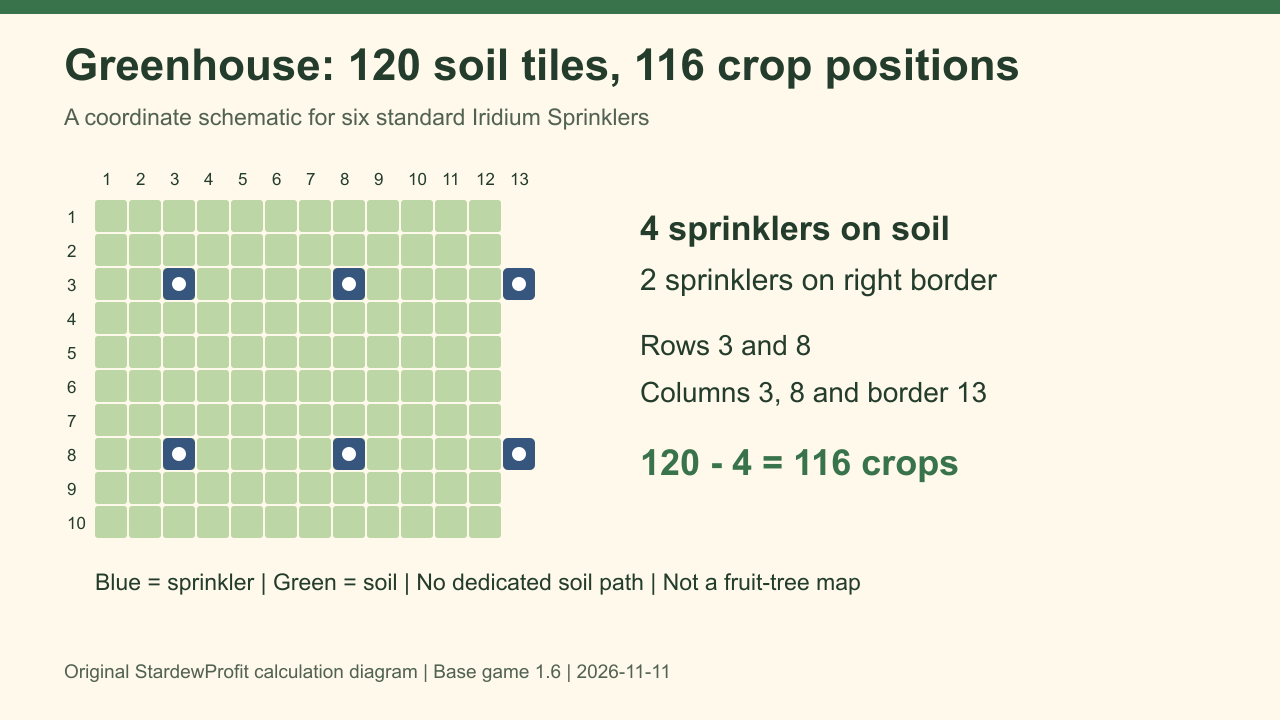
The greenhouse soil is 12 × 10, or 120 tiles. The pictured six-Iridium-Sprinkler layout occupies four soil tiles, leaving 116 for crops. That is one layout, not a fixed limit for every greenhouse. Read the coordinates, watering alternatives and access limits before choosing your planted count.
Sprinklers water; you still need to harvest. In a single-player save, a week of real time away from the game does not advance seven game days. Missing a harvest or a machine refill delays the next batch. Hops also needs a reachable route between trellises, so do not assume the same 116 positions remain accessible.
Existing stock: 116 Ancient Fruit, 20 machines, 7 full days
Start at 6am on plan Day 1 with 116 already-owned normal-quality fruit, empty existing machines and no professions. Compare twenty Kegs with twenty Jars as independent alternatives. Collect and refill each morning; sell unprocessed fruit raw at the deadline. Seven complete days end at 6am on Day 8.
| Alternative | Finished goods | Raw leftovers | Total sales value |
|---|---|---|---|
| 20 Kegs | 20 Wine × 1,650g | 96 fruit × 550g | 85,800g |
| 20 Jars | 40 Jelly × 1,150g | 76 fruit × 550g | 87,800g |
| Sell all fruit raw | None | 116 fruit × 550g | 63,800g |
Kegs finish one batch on Day 8. Jars finish two batches, on Days 4 and 7. The Jar alternative adds 24,000g over raw sales; the Keg alternative adds 22,000g. Add finished-goods sales and raw leftovers within one row, not across the two plans. This is sales value of existing inventory, not net farm profit or money already received from shipping.
Open this exact 116-fruit, 20-machine, seven-day comparison. The link sets crop, quantity, both machine counts, quality, professions and deadline.
Give the same stock more time and the answer changes
Keep that same stock and twenty machines, but allow 42 full days with no new harvests. Both alternatives can now finish all 116 fruit: Wine totals 191,400g and Jelly 133,400g. The last Wine batch is collected on Day 43; the last Jelly batch on Day 19. The short-deadline advantage of Jars does not make Jelly more valuable per fruit.
Recalculate with a 42-day deadline. A live greenhouse keeps adding fruit, so this finite-stock example cannot size an ongoing harvest line. Use the arrival-rate and synchronized-batch guide for that job.
If both crops are already in storage and share normal quality with no professions, a seven-day Wine slot adds 1,500g to a Starfruit over its 750g raw price, versus 1,100g to an Ancient Fruit over 550g. That can justify giving a scarce Keg to Starfruit while selling some Ancient Fruit raw. With Artisan, also include its Tiller prerequisite in the raw-sale comparison; do not multiply the processed bonus onto the raw price.
Try three greenhouse crop comparisons
These presets compare new plantings per tile over 112 growing days. They start on raw sales with the Artisan profession selected; its bonus applies only after you choose a supported processing route. Use the stock example above to include machine capacity and a deadline.
- Early greenhouse: Strawberry vs Blueberry
- Daily workload: Hops vs Cranberry
- Wine crops: Ancient Fruit vs Starfruit
温室刚解锁,可以先比较手头已有的种子;成熟上古水果适合每周收成,杨桃适合比较每个酒桶批次的售价。先用预设比较种植收益,再用上面的库存示例核对机器能否在期限内加工完。
Assumptions, sources and model limits
Wine takes 10,000 machine-minutes and preserves 4,000. This site rounds them to seven and three full-day morning slots; evening refills can produce a different schedule. The examples exclude Cask aging, machine construction, planting costs, shipping payment delays and any additional fruit arrivals. They do not optimize a mixed Keg-and-Jar fleet. Source: Keg recipes and timers and Preserves Jar recipes and timers.
The calculations and schematic explain a stated model; they are not an in-game test record. See the methodology for data scope and rounding, or compare fresh plantings over 112 growth days. That growing calculator compares per-tile scenarios rather than a constrained machine fleet.
Greenhouse questions
What is the best greenhouse crop for a weekly routine?
An established Ancient Fruit field fits a seven-day harvest routine without replacement seeds. It takes 28 growth days to reach its first harvest, so this recommendation assumes mature plants and enough machines or a plan to sell overflow raw.
Does the greenhouse have 116 or 120 crop spaces?
The soil contains 120 tiles. A layout with six standard Iridium Sprinklers places four on the soil and leaves 116 crop spaces. Other watering layouts and access paths can change the planted count.
Are Kegs always better for Ancient Fruit?
Wine pays more per fruit, but a short deadline can favor faster Jelly batches. With 116 already-owned normal fruit, 20 machines and seven full days, separate Keg and Jar plans yield 85,800g and 87,800g including raw leftovers, with no professions.
Reproduce the decision
Change the assumptions before applying a result to your save. The crop calculator ranks per-tile growing scenarios; the inventory processing planner checks existing stock and machine deadlines. Read the methods, source scope and known limits or send a correction with your version and inputs.