Stardew Valley 1.6 · Farm selection
Meadowlands Farm Guide: Chickens, Blue Grass & Your First Week
Choose Meadowlands if caring for animals sounds like part of the fun. Its early coop changes your first-week priorities: secure feed, preserve grazing space and plant only what fits beside that daily routine.
By StardewProfit · Reviewed
Watch the 1-minute visual guide ↓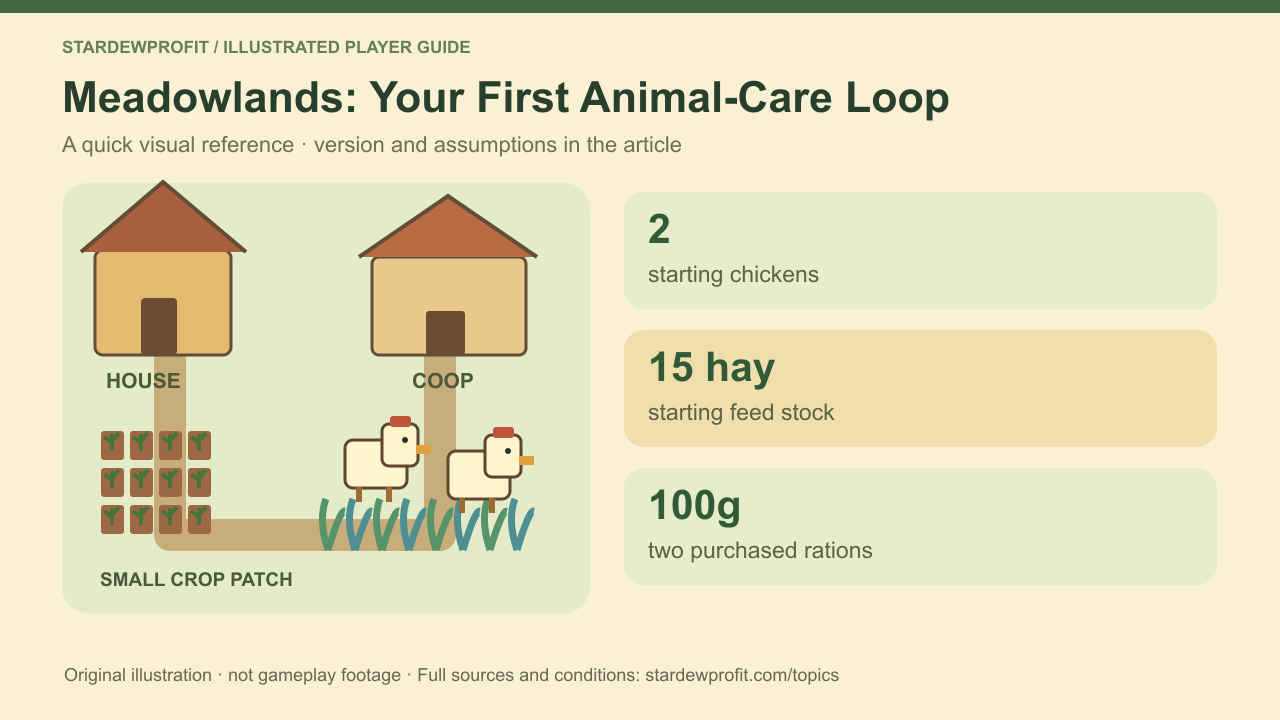
Choose it for an animal-focused routine
Meadowlands begins with a coop, two chickens and blue grass. The official 1.6 changelog confirms those starting advantages. The Wiki map comparison also records 15 hay in place of the usual Parsnip Seeds.
This is a good fit if you enjoy a short morning animal-care loop and a mixed farm. If your main goal is laying out a huge rectangular crop field, compare Standard Farm before committing. Decide which chores you want to repeat, rather than choosing solely from a screenshot of the finished map.
Treat the starting coop as a head start, then budget feed
| Building | Gold and materials | Build / footprint | Capacity |
|---|---|---|---|
| Basic Coop — already supplied | 4,000g + 300 wood + 100 stone if built separately | 3 days / 6×3 tiles | 4 animals |
| Silo — budget separately | 100g + 100 stone + 10 clay + 5 copper bars | 2 days / 3×3 tiles | 240 hay |
These are Robin's construction requirements, not the value of selling the building. Gather the silo materials before clearing grass; hopper access works regardless of the silo's distance from the coop. Sources: Coop, Silo.
At Marnie's regular 50g hay price, feeding two chickens entirely on purchased hay costs 100g per feeding day. The initial 15 hay covers seven complete two-chicken feeding days plus one ration, assuming no grazing or additional animals. This is a feed-budget example, not a promise of egg income. Source: hay price and feeding rules.
Keep blue grass reachable and retain a reserve
Blue-grass grazing adds 16 friendship, versus 8 from ordinary grass. Coop animals consume one blue-grass tuft instead of two ordinary tufts. A successful scythe hay drop from blue grass gives two hay rather than one; success is not guaranteed with every tool. Preserve reachable patches and leave room for spread. Source: blue grass mechanics.
Rain and winter still require a feeding plan. Check the feeding bench rather than assuming hay in your backpack has fed the chickens. Build a silo before scything grass for stored hay: grass harvesting needs available silo capacity. Leave some living grass to spread, and clear only the area your next project actually needs. Sources: hay storage and manual feeding, grass management.
For current 1.6 versions, do not plan around old advice that blue grass always spreads more slowly: the official 1.6.9 patch notes removed that difference.
Use a first-week checklist instead of buying everything
A fed chick needs three nights to mature. An adult, fed chicken produces daily; friendship and happiness affect the chance of a large egg. Check age before putting daily sales into a budget. Source: Chicken production.
| Checkpoint | Action or calculation | Decision branch |
|---|---|---|
| First morning | Check age, pet both birds and put needed hay on the bench. | If still chicks, treat the next fed nights as startup. |
| First 7 care days, hay-only | 2 birds × 7 days = 14 hay; 15 starting hay leaves 1. | That feed would cost 700g to replace at 50g each. |
| Before scything | Confirm a completed silo has spare capacity. | Without storage, preserve grass instead of clearing it for hay. |
| Before adding a third chicken | Check grazing access, reserve hay and daily care time. | Buy animals only if the extra feeding commitment fits. |
Grazing reduces hay consumed, so use your actual hay-only days when replacing this example. An extra chicken costs 800g at Marnie's before feed and housing expansion.
Egg and mayonnaise prices by quality and profession
| Egg stars | Small egg | Small + Rancher | Large egg | Large + Rancher |
|---|---|---|---|---|
| Normal | 50g | 60g | 95g | 114g |
| Silver | 62g | 74g | 118g | 141g |
| Gold | 75g | 90g | 142g | 170g |
| Iridium | 100g | 120g | 190g | 228g |
White and brown eggs share these prices. Artisan does not increase raw egg prices; use the ordinary columns for raw eggs when following that profession path. Sources: Egg, Large Egg.
| Mayonnaise quality | No bonus | Rancher | Artisan | Ordinary chicken input |
|---|---|---|---|---|
| Normal | 190g | 228g | 266g | Any star quality of small egg |
| Silver | 237g | 284g | 331g | Unavailable from chicken eggs |
| Gold | 285g | 342g | 399g | Any star quality of large egg |
| Iridium | 380g | 456g | 532g | Unavailable from chicken eggs |
One ordinary chicken egg takes three in-game hours to process. Size determines normal or gold mayonnaise; egg stars do not carry through. Silver and iridium mayonnaise come from Ostrich Eggs. Rancher and Artisan are separate choices, not stacked bonuses. Source: Mayonnaise prices and input rules.
Recalculate a productive week after both chickens mature
Assume two adults each lay one small egg on seven days, every egg is processed and sold, no profession bonus applies, and every feeding day uses purchased hay. This is a conditional operating example after maturation, not a forecast for the first seven days of a new save.
| Line | Calculation | Result |
|---|---|---|
| Eggs collected | 2 × 7 | 14 eggs |
| Mayonnaise sales | 14 × 190g | 2,660g revenue |
| Purchased feed | 14 × 50g | 700g expense |
| Sales less feed | 2,660g − 700g | 1,960g before other costs |
Subtract machine materials, purchased animals and building investment separately for payback. If you observe a missed product day, remove that sale while retaining any feed consumed; if you graze, replace the hay expense with actual purchases. Large eggs and professions require the matching table row.
Plan the crop patch you can work, not the entire map
The Wiki lists 2,066 tillable tiles on Meadowlands. That total does not describe a single unobstructed field or your day-one watering capacity. Mark out a small patch near convenient water and keep access to the coop clear. Source: Farm Maps.
Use the crop calculator to compare the season and remaining growing time for that patch. It ranks crop scenarios; it does not allocate Meadowlands buildings, grazing space or animal-care time. Multiply a per-tile result only by the positions you can actually plant and maintain. Our first-spring crop guide helps separate seed spending from expected harvest receipts.
Review products before choosing the next upgrade
Record what your chickens produce over several normal days, then compare selling products with processing them. Read the animal margin examples with your actual product size and profession. Reserve hay expense before treating sales as money available for construction.
If care feels easy and feed is secure, expansion may fit your routine. If the coop or crop patch is being neglected, simplify first. The useful advantage of Meadowlands is starting an animal system early enough to learn what you enjoy managing.
Watch the 60-second illustrated walkthrough
A silent, original visual guide with English captions. The drawings explain the decisions; they are not gameplay footage.
Read the full video transcript
- 0s — Start with the actual stock. Meadowlands starts with a coop, two chickens and 15 hay instead of the usual Parsnip Seeds. Set aside money for a small crop patch.
- 12s — Make a short morning loop. Start your morning with feed, care and available products. Keep the route between house, coop, grass and crops easy to use.
- 24s — Price the non-grazing day. At Marnie's 50g price, two purchased hay rations cost 100g. This is a feeding-cost example, not an egg-profit guarantee.
- 36s — Keep a feed reserve. Fifteen starting hay covers seven full two-chicken feeding days and leaves one ration, if no grass is eaten and no animals are added.
- 48s — Grow at a manageable scale. Use a manageable crop patch beside the animal routine. Expand only after feed, daily care and cash reserves are comfortable.
Open the dedicated watch page for the video, transcript and sources.
Frequently asked questions
Does Meadowlands Farm start with chickens and a coop?
Yes. It starts with a coop and two chickens. You receive 15 hay instead of the usual 15 Parsnip Seeds, so crop seeds need a separate budget.
Does blue grass double egg income?
Blue grass gives more friendship from grazing. It does not directly double egg prices or guarantee a particular daily product. Feed, care, maturity and processing still matter.
How much tillable land does Meadowlands Farm have?
The Wiki lists 2,066 tillable tiles for the full map. That is not a ready-to-plant rectangle: buildings, routes, water access and your clearing plan determine usable crop space.
Do I need to buy hay if blue grass is available?
Keep a hay reserve for days animals cannot graze. Purchased hay costs 50g each at Marnie's Ranch, and a basic coop requires you to put feed on its bench.
How long does a chick take to mature?
A chick that eats every day matures after three nights. Once mature and fed, a chicken can produce an egg daily. Large eggs depend on friendship and happiness, so budget the startup nights separately.
Does an iridium chicken egg make iridium mayonnaise?
No. Ordinary small chicken eggs make regular mayonnaise and large chicken eggs make gold mayonnaise, regardless of egg stars. Silver and iridium mayonnaise require Ostrich Eggs.