Stardew Valley 1.6 · Decision guide
Stardew Valley Keg vs Preserves Jar: Cranberry Wine or Jelly?
Use Preserves Jars for a pile of Cranberries. One normal berry sells for 75g raw, 225g as Wine, or 200g as Jelly without professions. Jelly finishes sooner. Use a spare Keg when you can wait a week and have no higher-value crop waiting for that slot.
By StardewProfit · Revised
Are Cranberries good in a Keg?
With seven full days and one empty machine, a Jar earns 700g from six normal Cranberries, compared with 600g for a Keg. Start on the first morning, collect and refill once each morning, and sell unfinished stock raw on the eighth morning. This example uses fruit you already own, no professions and no Cask aging.
| Use of six berries | Finished goods | Raw berries sold | Total sales |
|---|---|---|---|
| One Preserves Jar | 2 Jelly × 200g | 4 × 75g | 700g |
| One Keg | 1 Wine × 225g | 5 × 75g | 600g |
| Sell raw | None | 6 × 75g | 450g |
The Jar adds 250g over the raw sale, and the Keg adds 150g. If you have just one berry and can wait the full Wine cycle, the Keg pays 25g more than Jelly. With Artisan, those finished products sell for 315g and 280g respectively. Keep the Keg free if a higher-value input such as Starfruit will need it before your Cranberry Wine finishes.
Check the crop prices and machine times in the Stardew Valley Wiki. Cranberries · Keg · Preserves Jar.
20 Cranberries and two machines: 3, 7 or 14 days
Start with 20 normal Cranberries and either two empty Kegs or two empty Jars. Load on the first morning and refill at each morning collection. Use raw sales for the berries left at the cutoff. With no professions, selling the whole stack raw is worth 1,500g.
Run the seven-day Cranberry example to compare cutoff sale value, shipping payouts and how many machines would clear all 20 berries.
| Collection deadline | Two Kegs | Two Preserves Jars |
|---|---|---|
| 3 full days (morning 4) | 0 Wine + 20 raw = 1,500g | 2 Jelly + 18 raw = 1,750g |
| 7 full days (morning 8) | 2 Wine + 18 raw = 1,800g | 4 Jelly + 16 raw = 2,000g |
| 14 full days (morning 15) | 4 Wine + 16 raw = 2,100g | 8 Jelly + 12 raw = 2,500g |
For a different stack, multiply the number of machines by the number of whole slots that fit before the deadline. Cap that result at your berry count. In this schedule a Wine slot lasts seven days and a Jelly slot lasts three. Load only the batches you can collect by the cutoff, then sell or save the remaining fruit. If you can wait for all 20 berries, two Kegs need 70 days for 4,500g of Wine and two Jars need 30 days for 4,000g of Jelly. That extra 500g takes another 40 days of morning reloads.
If the cash needs to be spendable by Fall 12, loading on Fall 8 gives Jelly on the Fall 11 morning check and shipping money on Fall 12. Wine from the same morning load can be collected on Fall 15 and paid on Fall 16. Shipping the raw berries on Fall 8 pays on Fall 9. Leave the extra night when the deadline is a purchase. How shipping pays out.
Which berries deserve a machine slot?
Process the lowest-quality berries first when space is tight. Input stars raise raw prices and leave the fresh Wine and Jelly prices fixed. Compare each product with the sale value of that same berry.
| Berry and professions | Raw price | Wine gain over raw | Jelly gain over raw |
|---|---|---|---|
| Normal, no professions | 75g | 150g | 125g |
| Iridium, no professions | 150g | 75g | 50g |
| Iridium, Tiller without Artisan | 165g | 60g | 35g |
| Iridium, Tiller and Artisan | 165g | 150g | 115g |
Say you have one Keg, one normal Cranberry, one normal Starfruit and one seven-day slot. Putting Starfruit in the Keg and selling the berry raw brings 2,325g. Brewing the berry and selling Starfruit raw brings 975g. Use that slot on Starfruit for 1,350g more by the cutoff. A spare Keg is useful for Cranberries when it can finish before it is needed for something else. Starfruit prices · Keg gains with Tiller · Jar gains with Tiller.
Start with the correct recipe
| Route | Normal output price | Example without Artisan |
|---|---|---|
| Fruit → Wine | 3 × base fruit price | Starfruit: 750 × 3 = 2,250g |
| Vegetable → Juice | floor(2.25 × base price) | Pumpkin: 320 × 2.25 = 720g |
| Jelly or Pickles | 2 × base price + 50 | Starfruit Jelly 1,550g; Pumpkin Pickles 690g |
Artisan multiplies eligible output prices by 1.4, rounded down. Input stars and Tiller do not multiply wine, juice or preserves prices. Hops makes Pale Ale, Wheat makes Beer, and five Coffee Beans of the same quality make one 150g Coffee in 120 machine-minutes. Coffee Beans receive no Tiller bonus, and Coffee receives no Artisan bonus. Flowers are not generic wine ingredients. Sources: Keg recipes and Preserves Jar recipes.
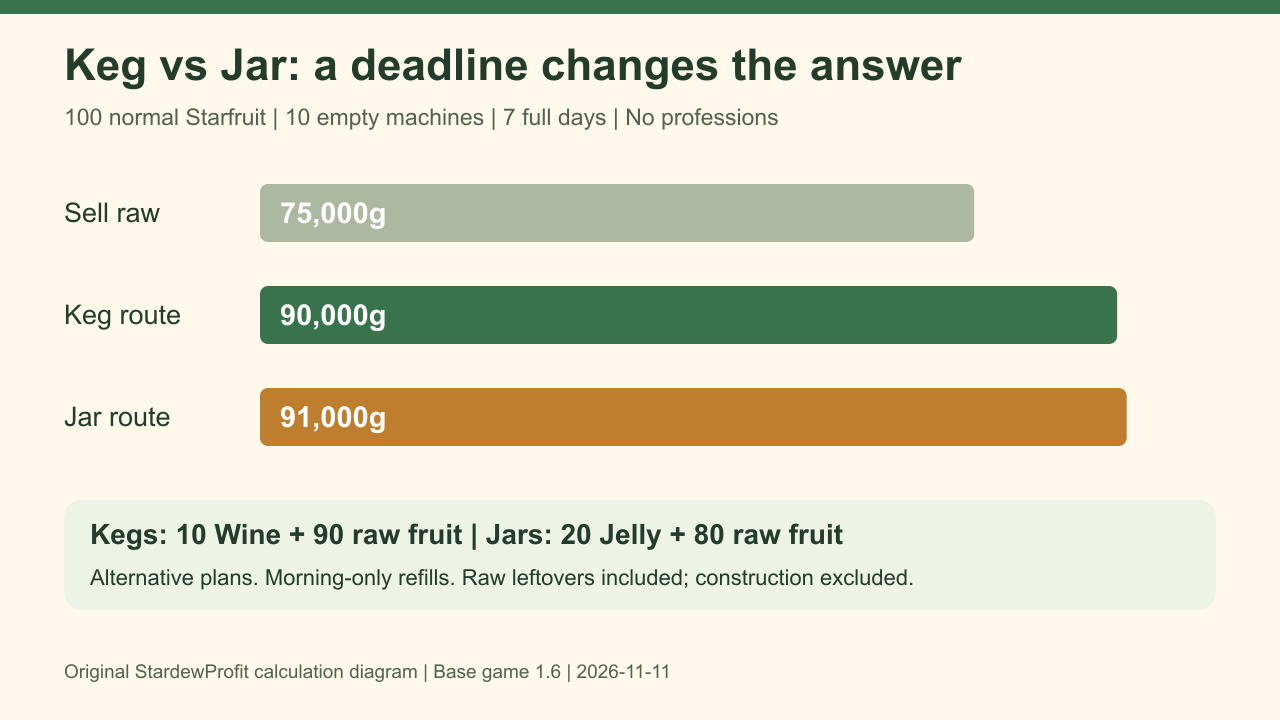
100 Starfruit, 10 machines, 7 full days: Jars edge ahead
Use normal Starfruit already owned, empty machines now, no professions, and morning-only refills. We reserve seven full days per Wine batch and three per preserve batch. Each route is an alternative use of the same fruit.
| Alternative | Completed by deadline | Raw leftovers | Total sales |
|---|---|---|---|
| 10 Kegs | 10 Wine × 2,250g | 90 × 750g | 90,000g |
| 10 Jars | 20 Jelly × 1,550g | 80 × 750g | 91,000g |
| Sell everything raw | None | 100 × 750g | 75,000g |
The Jar route adds 16,000g over raw sales, versus 15,000g for Kegs. This is inventory value, not farm net profit: crop production and machine construction costs are already outside this question.
20 Starfruit, 10 machines, 14 days: Kegs win
Both alternatives can finish all twenty fruit, so speed no longer rescues the lower unit price. Wine brings 45,000g; Jelly brings 31,000g. The normal raw baseline is 15,000g. Kegs add 30,000g versus 16,000g from Jars. Change stock or deadline and the ranking can change again.
High quality makes raw selling a real alternative
An iridium Pumpkin with Tiller sells for 704g. With no Artisan, Pumpkin Juice sells for 720g and Pickles for 690g. A Jar would reduce that item’s value by 14g, so the planner leaves it raw. The Keg adds only 16g, which may be a poor use of a machine needed for better stock.
Opportunity cost means subtracting what that exact item could sell for now, rather than subtracting a normal-quality price. Compare harvested Pumpkin processing with one iridium Pumpkin, one of each machine, seven full days, Tiller on and Artisan off.
Try three growing and processing presets
Each preset starts with 15 days left (including the planting day) and Artisan selected. Change the sale route to compare eventual net profit per tile after seed and fertilizer costs. The presets do not model the number of machines or how long the harvested crops wait for a free slot.
- Starfruit vs Melon for Wine · 杨桃与甜瓜:酿酒
- Pumpkin Pickles vs Cranberry Jelly · 南瓜腌菜与蔓越莓果酱
- Hops Pale Ale vs Blueberry Wine · 啤酒花淡啤与蓝莓酒
Already harvested the crop? Start from your stock and deadline instead. Comparing a continuous harvest? Use the recurring processing queue to estimate how many machines can keep up.
Timers and the boundary of this comparison
Actual timers are 10,000 minutes for Wine, 6,000 for Juice, and 4,000 for preserves. Our morning schedule rounds these into 7, 4 and 3 full-day slots. Evening collection, overnight timer behavior, mixed machines and new harvest arrivals can change an optimized schedule. See processing time and productivity.
Enter an available crop, inventory, machines, quality, professions and deadline. The tool shows completed batches and raw leftovers for the supported crop options.
Reproduce the decision
Change the assumptions before applying a result to your save. The crop calculator ranks per-tile growing scenarios; the inventory processing planner checks existing stock and machine deadlines. Read the methods, source scope and known limits or send a correction with your version and inputs.